
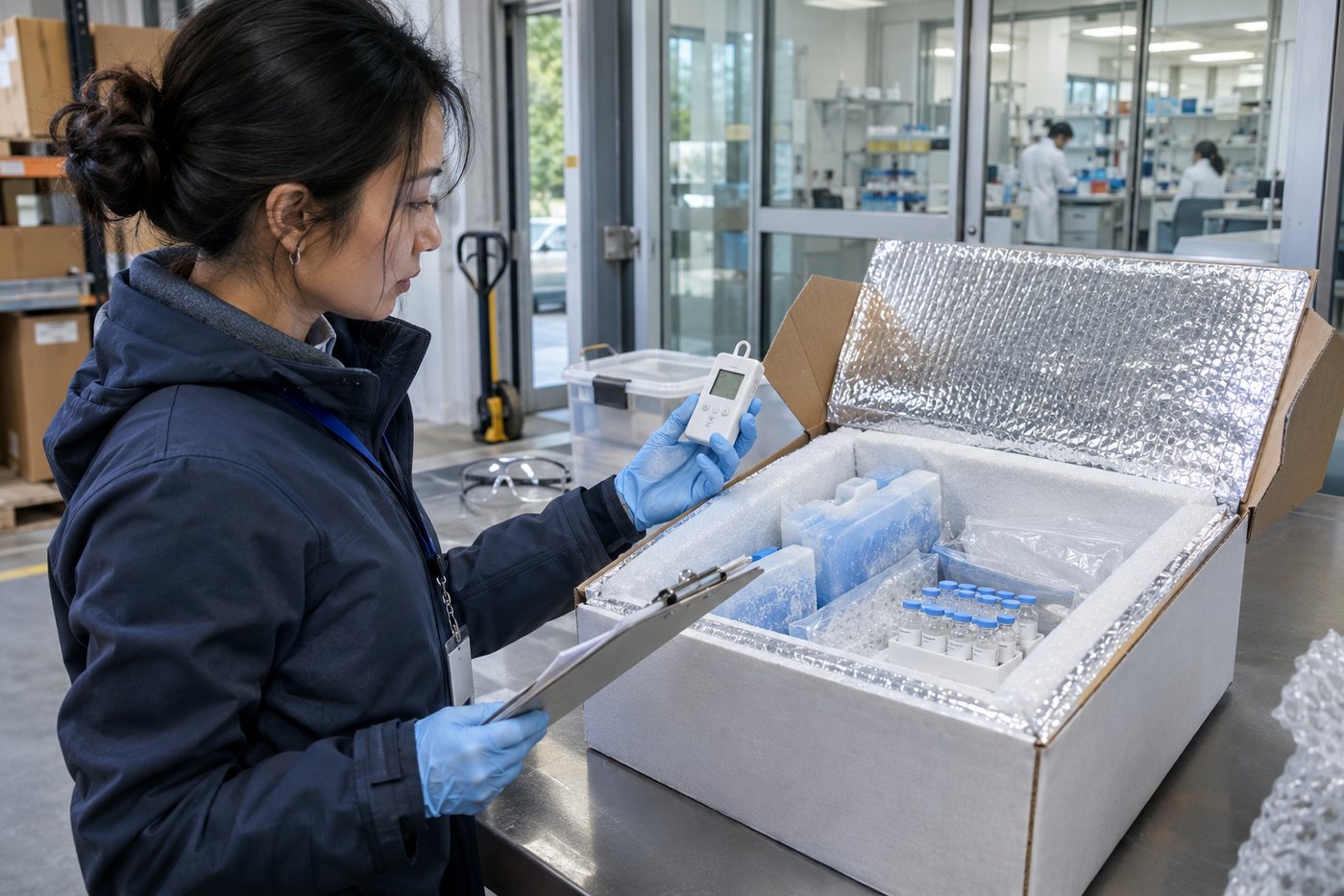
Quick answer: a cold-chain handoff is complete only when the receiving team can show who accepted the shipment, what temperature evidence was available, what happened during any excursion and who approved release. Do not decide from appearance alone; keep the shipment segregated while the evidence is reviewed.
1. Define the handoff before the shipment moves
Agree the handoff owner, destination, receiving hours, storage location and the temperature range or handling instruction supplied for the specific product. The peptide product catalogue helps identify the product and pack, but the supplier’s lot or shipping instruction is the reference for the actual shipment.
For a concrete product record, see the Semaglutide research-use product page.
- Assign one person for carrier handoff and one backup.
- Record dispatch time, tracking and expected arrival.
- Confirm who can place material on hold.
- Do not invent a temperature range when the shipment documentation does not state one.
2. Preserve packaging and logger evidence
At arrival, photograph the outer carton, seal, insulation and any temperature logger before opening more than necessary. Record the time, package condition and reading. Keep the logger, packing list and lot information together with the receiving record; a screenshot in a private chat is not a durable audit trail.
- Record logger ID, start/stop status and displayed reading.
- Note damaged insulation, warm packs, condensation or delay.
- Keep vials segregated until the review is complete.
- Link the evidence to the lot and order number.
Once the shipment is logged, continue with the peptide SKU specification checklist and the supplier SLA and escalation scorecard.
3. Handle excursions with a written decision
A temperature excursion is a review event, not an automatic release or rejection. Place the shipment on hold, preserve the logger file and ask the supplier or quality contact how the excursion should be assessed for the specific product and lot. Do not use colour, appearance or a generic online rule as a substitute for the documented decision.
- State the time window and highest or lowest recorded value.
- Ask whether the product, lot and pack configuration remain acceptable.
- Record the response, reviewer and decision date.
- If evidence is incomplete, keep the material segregated and set a follow-up owner.
4. Close the loop after release
Once the team decides released, held or rejected, keep the reason with the order and update the supplier scorecard when the event reveals a weak handoff. The lot-specific peptide COA review supports document review, while the B2B quote request page can route a lot-specific question. Repeat events should change the packing instruction, carrier route or receiving checklist.
- Use the same status terms at every site.
- Attach the final logger file or a clear reference.
- Record corrective action and owner.
- Review repeat excursions during the next supplier meeting.
For routine delivery questions, see the B2B peptide purchasing FAQ; for a lot or document question, use the B2B quote request page. Related workflows are collected in the B2B peptide documentation guides.
B2B buyer questions
Question: Can we release a shipment if the vials look normal?
Answer: No. Appearance does not prove that the documented temperature requirements were met. Keep the material on hold until the responsible reviewer completes the evidence-based decision.
Question: What if the logger is missing?
Answer: Record the missing evidence, keep the shipment segregated and ask the supplier for the approved assessment route. Do not backfill a reading from memory.
Question: Should every order have a temperature logger?
Answer: Use the logger and packing method required by the product and shipping instruction. Document the decision when a logger is not used.
Research-use note: The products discussed are for laboratory research and procurement evaluation only. This article is not medical, dosing or treatment advice.
Lyophilized transit temperature excursion decision matrix
Because lyophilized dry peptide powder is substantially more thermally stable than reconstituted liquid solutions, distinguish actual risk from harmless ambient exposure before rejecting a shipment:
| Arrival Condition | Physical & Log Evidence | Recommended Disposition |
|---|---|---|
| Dry lyophilized cake, ≤ 10 days ambient transit (≤ 30 °C) | Intact white cake; no moisture ingress; seal unbroken | Accept into -20 °C / 2–8 °C storage; verify routine batch COA |
| Warm-season transit > 35 °C or prolonged customs hold (> 14 days) | Logger spike > 35 °C or delayed clearance | Place on hold; test sample vial for solubility & confirm HPLC purity before release |
| Collapsed, sticky, or discolored cake / wet outer carton | Visible moisture or seal breach | Reject / quarantine 100%; document with photos and escalate to supplier |