
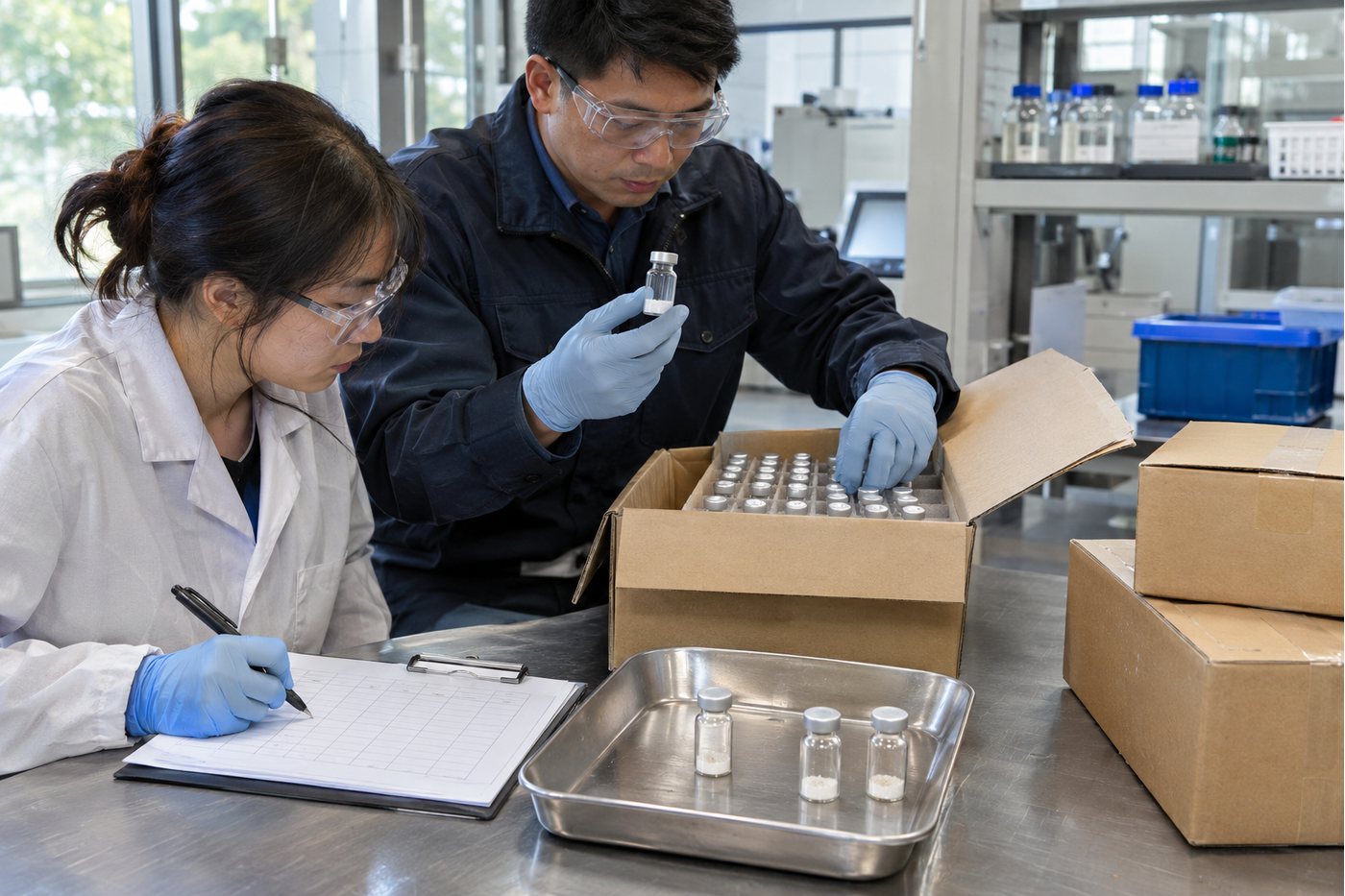
There is no safe universal number that fits every product, lot, package and internal SOP. Start with your inspection goal, identify the lot, select units randomly across the shipment, and define what happens when one check fails. The worksheet below is an illustrative process, not a regulatory sampling rule.
Use the Retatrutide research-use product page as the catalogue record, then match the shipment documents to the exact SKU and lot.
Define what the pilot is testing
Illustrative worksheet
| Pilot lot | Shipment units | Illustrative visual sample | Record |
|---|---|---|---|
| L-Example-A | 12 vials | 3 units from different positions | label, seal, carton, lot match |
| L-Example-B | 48 vials | 6 units across cartons | same fields plus damage count |
These sample counts are example assumptions only. Your quality lead should set the actual plan, especially when a contract, destination rule or validated method requires a different approach.
Randomise and record the chain
Set an escalation path
Buyer questions
Can I inspect one vial and release the lot?
Not as a universal rule. One unit may be a first visual check, but your SOP must define representative sampling and escalation.
Does visual inspection prove identity or purity?
No. It checks visible condition and label/document linkage only.
What should be recorded?
Lot, sample positions, selector, date, observations, photos, document version and final disposition.
Research-use note: this article supports laboratory procurement and document review only. It is not medical, dosing or treatment advice.
Related procurement tools: commercial invoice and packing-list checklist for peptide export and COA, SDS and specification-sheet document map.
Visual attribute inspection vs. analytical sampling split
In pilot peptide orders, separate non-destructive visual inspection (outer seal, label match, lyophilized cake check across every kit) from destructive laboratory sampling (consuming 1–2 vials per lot for independent RP-HPLC/MS testing):
| Pilot Order Size | Non-Destructive Visual Check | Analytical Lab Sample (if tested) |
|---|---|---|
| 10–20 vials (1–2 kits) | Inspect 100% of kit labels + at least 3 vials across positions | 1 vial per batch (retain matching COA & sealed control) |
| 30–50 vials (3–5 kits) | Inspect 100% of kit seals + 1–2 vials from every kit box | 1–2 vials sampled across first, middle, and last kit |
Quality rule: Reference your internal SOP or ISO 2859-1 attribute-sampling plan if moving to routine multi-carton wholesale batches.