
Short answer: keep the shipment on hold when the lot-specific COA is late unless your written quality procedure allows a documented conditional decision. Match the lot, SKU, form, pack count and seal first; record who owns the deviation, what evidence is missing and when the final COA must arrive. A packing slip or supplier promise is not a substitute for the final batch record.
Record the hold before chasing the document
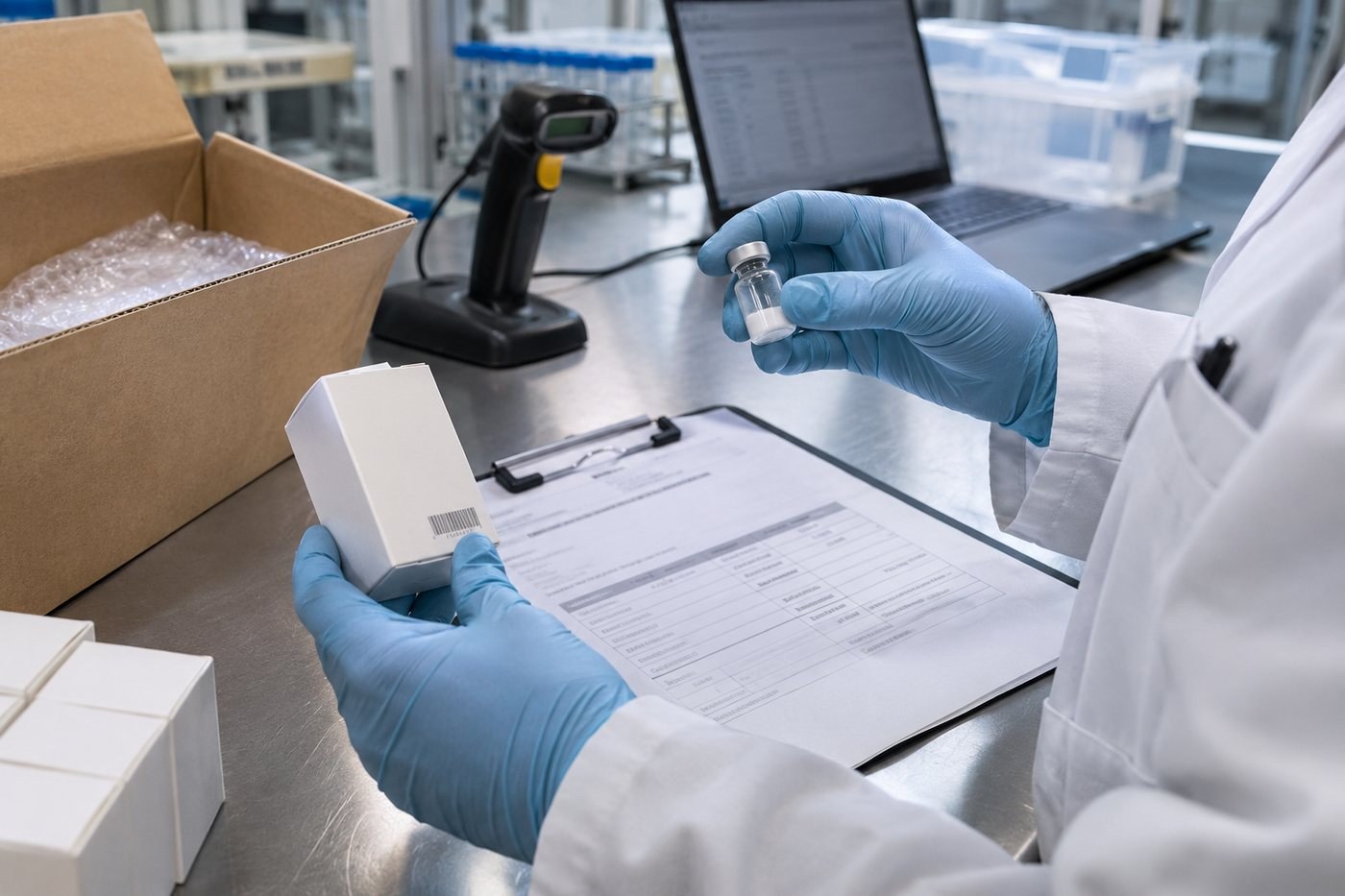
Open a receiving hold against the shipment number and list the affected SKU, lot, form, strength, units, seal condition and arrival date. Photograph the carton and label, then put the units in a clearly marked quarantine location. A hold is a controlled status, not a statement that the material failed.
What can be checked before the COA arrives
| Evidence | Check | What it can and cannot prove |
|---|---|---|
| Purchase order | SKU, form, pack size, quantity and destination | Confirms what was ordered; not analytical identity. |
| Label and seal | Lot, strength, unit, tamper evidence and damage | Supports traceability; does not replace a COA. |
| Packing record | Count, carton number and ship date | Supports receipt reconciliation; not release evidence. |
| Transport record | Damage, temperature indicator or carrier note | Shows a logistics event; needs quality assessment. |
| Supplier statement | Expected COA date and document version | Explains timing; is not the final result. |
Use the lot-specific COA reports page when the document arrives, and keep the original file name and revision date. ICH Q7 is a useful reference for documented quality systems and material traceability.
When a conditional release is defensible
Only use a conditional path if your own written procedure names the approver, the permitted evidence and the deadline for closing the gap. A practical record should state “released for the defined internal purpose, pending COA”, identify the lot and quantity, and block onward sale or transfer if your procedure requires it. Do not use a conditional release to make missing identity, wrong form, broken seal or unexplained transport damage disappear.
- Quality or operations owner approves the deviation in writing.
- Lot and label reconcile to the order and packing record.
- Supplier confirms the COA is being issued for that exact lot.
- A due date and escalation owner are recorded.
- Final release is re-signed when the COA is reviewed.
Close the deviation and preserve versions
When the COA arrives, compare the lot, form, unit, method, result and document version with the hold record. If the result or identity conflicts, keep the material on hold and open a new investigation. If the supplier sends a corrected COA, keep both files and note what changed; never overwrite the original evidence. For questions about a specific lot, contact the B2B purchasing team via the contact page. Related receiving examples are in the damaged-label receiving checklist.
Research-use note: this guide supports laboratory purchasing and document control only. It is not medical, dosing or treatment advice.
research peptide catalogue · lot-specific COA reports · B2B purchasing team · purchasing FAQ · B2B documentation blog
Can a packing list replace the COA?
No. It supports count and shipment reconciliation but does not provide the lot-specific analytical result.
Can I release one SKU while another is missing its COA?
Only if your written procedure permits a line-level decision and the lots remain separated.
Who should own the deviation?
Name a quality or operations owner with authority to hold, conditionally release or reject.
What if the late COA fails?
Keep the lot blocked, record the failure and follow the documented investigation or return process.